
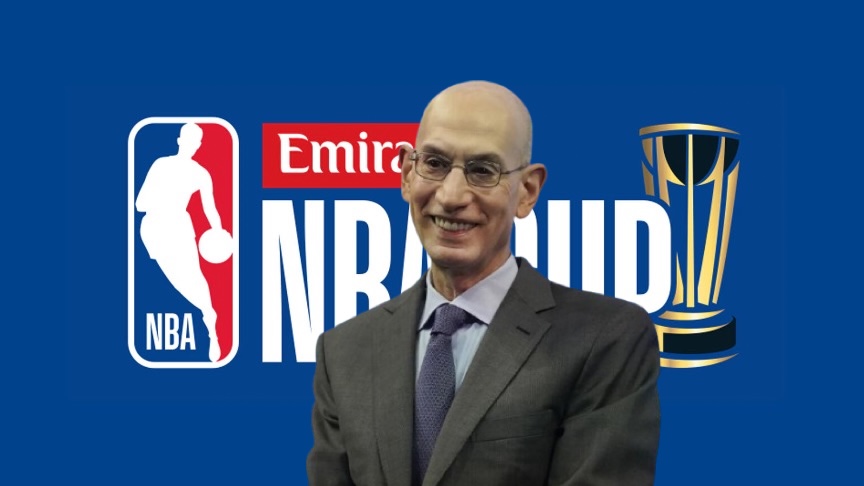
The NBA doesn’t usually brag about television numbers unless it thinks the numbers are making a point. And with the Emirates NBA Cup, the league is very clearly making a point: the product looks healthier when it’s easier to find.
The NBA announced that more than 40 million people in the United States watched Emirates NBA Cup Group Play games across Amazon Prime Video, NBC/Peacock, and ESPN – an increase the league pegged at 90% year-over-year, and the most-watched Group Play in the event’s three-year history.
That headline is the kind that travels fast, because it lands in the middle of the NBA’s biggest ongoing argument: not whether fans like basketball, but whether fans can access basketball without turning viewing into a scavenger hunt.
The Cup’s jump is being framed as proof that the new distribution map is working. This season, national NBA games are spread across ABC/ESPN, NBC/Peacock, and Prime Video, reflecting the league’s new rights landscape and a dramatic shift away from the old cable-first era.
The NBA Cup, specifically, has leaned into Prime Video as a signature home for the knockout rounds, exactly the kind of “appointment” packaging streamers want, and exactly the kind of clarity fans respond to when a competition is still teaching people why it matters.
There’s also a second layer here that matters if you want to be precise about what this surge means. The broader sports-media world has been updating how it counts viewers, most notably through Nielsen’s newer “Big Data + Panel” approach and expanded out-of-home measurement, which can lift reported audiences compared with older methodologies. That doesn’t erase the NBA’s momentum, but it does mean the cleanest interpretation isn’t “the league magically found 90% more diehards overnight,” so much as “the league improved both distribution and measurement at the same time.”
Still, even with that caveat, it’s hard to miss what the Cup is revealing about modern NBA fandom. A meaningful chunk of the audience doesn’t build its week around a cable grid anymore. Some fans, like you, actively opt out of ESPN and League Pass. And whether that’s about cost, habit, interface fatigue, blackout frustration, or just not wanting yet another subscription, the behavior is real: if the game isn’t where you already are, you’re less likely to chase it.
This is why the “cable locked people out” argument resonates, even if the truth is a little more nuanced. Cable didn’t only lock people out by price; it locked them out by friction. The old model often asked casual and lapsed fans to climb a wall, provider packages, channel tiers, regional-network weirdness, and a viewing experience that could feel designed for the already-committed. The new model has its own fragmentation problem, but it also places more inventory on platforms people already use for entertainment, not just sports.
Commissioner Adam Silver has effectively acknowledged both sides of the tension. In September 2025, when asked about the rising cost and complexity of watching games across multiple services, he pointed to the NBA as a “highlights-based” ecosystem, suggesting fans can consume a large amount of NBA content for free through social and digital platforms, while also noting the increase in over-the-air availability compared to prior years.
In other words: the league sees the funnel. It wants the obsessed fan, the casual fan, the highlights-only fan, and the “I’ll tune in when it feels like an event” fan. The Cup is designed to convert the last two into the first two.
And that’s the real takeaway from the 40-million, 90%-up headline. The Emirates NBA Cup is not just a midseason trophy experiment anymore; it’s becoming a laboratory for how the NBA wants its games to live in the streaming era: clearly branded windows, concentrated stakes, and fewer barriers between “I heard something’s on” and “I’m watching.”
If the league keeps learning the right lesson, reduce friction, increase clarity, and make games feel like events without making fans feel like hostages, then the Cup’s surge won’t be a one-off press release. It’ll be a preview of what “booming” actually looks like in 2026 and beyond.
