
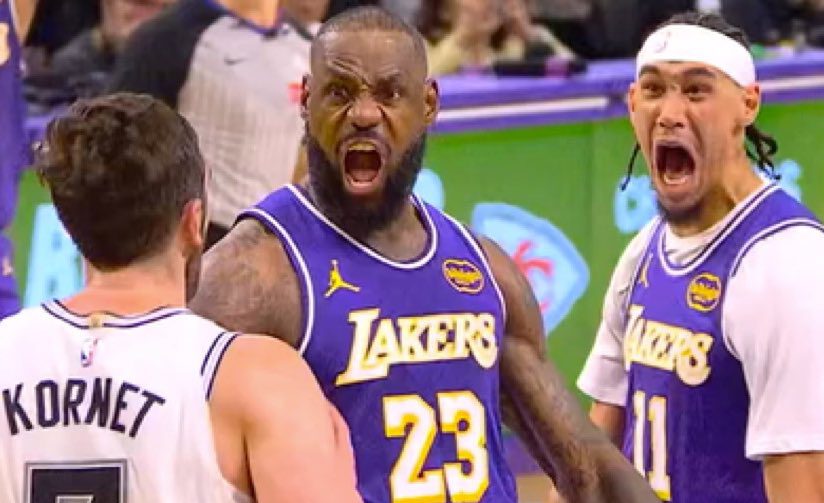
The San Antonio Spurs delivered one of the most surprising performances of the NBA Cup season, defeating the Los Angeles Lakers 132–119 to advance to the semifinals and they did it without their franchise star Victor Wembanyama, their cornerstone and the most important piece of their future.
On a night where the Lakers leaned heavily on their star power and offensive firepower, with Luka Doncic scoring 38 points, 8 assists and 5 rebounds as the Spurs countered with cohesion, discipline, and an upset performance that could signal a changing of the guard in San Antonio.
Rookie guard Stephon Castle put together the most impressive game of his young career and has shown to NBA fans that he has arrived here in this league and showcasing his poise well beyond his experience. From the opening tip, Castle looked assertive in the game and ready for the moment in this game, attacking gaps in the Lakers’ defense, pushing the pace, and creating shots for his teammates. His scoring production set the tone early for the Spurs, and his rebounding and defensive energy helped stabilize the Spurs whenever the Lakers threatened to make a run during the game.
Stephon Castle’s emergence was the biggest headline of the night for San Antonio. He handled the ball under pressure, made strong reads from pick-and-roll situations, and knocked down mid-range looks the defense was allowing him to take all night. If there was a question of who might step into the spotlight with Wembanyama sidelined, Castle answered the bell convincingly last night.
The Spurs’ victory wasn’t just about one player. It was a collective team effort built on ball movement, spacing, and disciplined execution. De’Aaron Fox scored 20 points, 3 assists and 4 rebounds, while Harrison Barnes, Julian Champagnie and Keldon Johnson provided steady scoring on the wings. San Antonio’s ability to punish defensive breakdowns was the difference maker. Every unnecessary gamble by the Lakers, every late rotation or miscommunication, turned into a Spurs bucket it seemed like. They moved the ball freely, drove into the heart of the defense, and made the paint a constant source of advantage.
Despite huge games from Luka Dončić and LeBron James, Los Angeles failed to keep pace in the second half. Dončić was perfect as a scorer and facilitator, and LeBron continued to defy age and Father Time with shot-making and physicality at the rim with a huge dunk in the game but their combined performances wasn’t enough to cover the structural issues that ultimately cost them the game:
1. Defensive Breakdowns
The Lakers struggled to contain dribble penetration, leaving shooters open and allowing the Spurs to dictate tempo. Defensive focus wavered repeatedly, especially in transition and pick-and-roll coverages.
2. Bench Inconsistency
The Spurs got impactful minutes from their role players, while LA’s second unit failed to deliver enough scoring or defensive relief.
3. Overreliance on Stars
Dončić and James created nearly every quality offensive possession for Los Angeles. But long stretches of isolation and slow tempo allowed San Antonio to control the flow of the game.
The Spurs’ victory over the Lakers wasn’t just a strong on-court performance, it was a reflection of the organization’s long-term vision. San Antonio’s front office, led by GM Brian Wright, has spent the past several seasons quietly and deliberately assembling a roster built for sustainable success. From drafting high-IQ, versatile players like Stephon Castle and Devin Vassell, to developing complementary pieces such as Dylan Harper and Keldon Johnson, Wright has prioritized talent that fits a clear identity: unselfish, disciplined, and poised under pressure.
That strategic approach was on full display in this win. Even without Victor Wembanyama, the Spurs looked cohesive and confident as a team, a testament to Wright’s commitment to building a balanced team rather than relying solely on star power. Castle’s breakout performance is just the latest example of the front office identifying the right talent at the right time and trusting in the development system San Antonio has become known for.
As the Spurs move on to face the red-hot Oklahoma City Thunder in the NBA Cup semifinals, their trajectory feels different now. This isn’t a team waiting for the future, this is a franchise whose future is arriving faster than anyone expected. If performances like this continue, and if Brian Wright’s roster blueprint keeps unfolding the way it has, the Spurs may soon reclaim their place among the league’s most consistently competitive teams. With or without Wembanyama, San Antonio is building something real and the rest of the NBA is starting to notice.
