
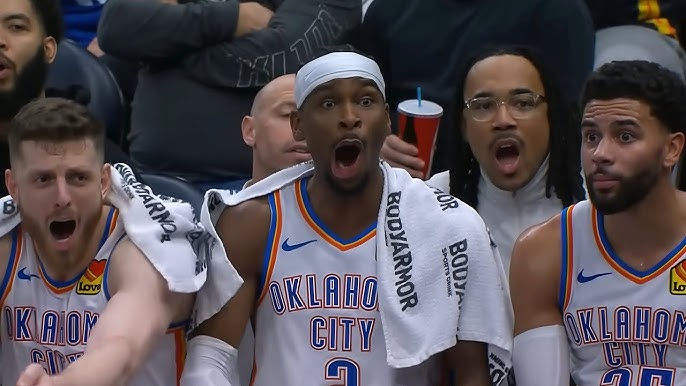
Through 25 games of the 2025-26 season, the Oklahoma City Thunder aren’t just defending a title, they’re stress-testing the limits of what dominance in the modern NBA can look like.
With a 138–89 demolition of the Phoenix Suns in the NBA Cup quarterfinals, Oklahoma City moved to 24–1, tying the best 25-game start in league history, a mark previously held by the 2015-16 Golden State Warriors.
They’ve outscored opponents by 437 points overall, translating to roughly +17.4 points per game, the largest point differential ever recorded through 25 games. That’s about 90 points better than the previous benchmark set by the 2007-08 Boston Celtics for the same segment of the season.
This isn’t a hot streak. It’s a sustained, system-level demolition of the league.
The Suns game crystallized just how absurd this stretch has been. Short-handed or not, Phoenix walked into Oklahoma City and left on the wrong side of a 49-point margin, 138–89 – the worst loss in franchise history, eclipsing two previous 48-point defeats.
That 49-point gap didn’t just bury Phoenix; it reset the tournament record books. It is the biggest blowout ever in an NBA Cup bracket game, surpassing a previous 44-point mark.
Even more telling, Oklahoma City has spent more time leading by 20+ points than they’ve spent trailing at all this season. For a reigning champion, this isn’t just “taking care of business.” It’s turning games into three-quarter scrimmages.
The comparison that keeps surfacing is obvious: the 2015-16 Warriors, owners of the 73-win record and now co-holders of the best 25-game start at 24–1. Golden State opened 24–0 that year before dropping their 25th; the Thunder have essentially mirrored that start in a league that’s deeper, more three-point heavy and more load-managed than it was a decade ago.
If Golden State is the stylistic comparison, Boston provides the statistical benchmark. The 2007-08 Celtics, the Garnett/Pierce/Allen group that won 66 games and a title, famously blitzed the league out of the gate and held a +13.9 point differential through 25 contests. Oklahoma City has pushed that standard into a different weight class:
Celtics through 25: +347 (approx. +13.9 per game)
Thunder through 25: +437 (approx. +17.5 per game)
In a season after they already posted the biggest full-season scoring margin in NBA history at +12.9 per game en route to a 68–14 record and the 2025 title, the Thunder have somehow turned the dial even further.
Last year, they were the best team in basketball. This year, through 25 games, they’re flirting with outlier territory even those Warriors and Celtics teams didn’t touch this early.
Every dynasty-caliber team needs a gravity source, and for Oklahoma City it’s Shai Gilgeous-Alexander, the reigning MVP who looks somehow better than he did during last season’s 32.7-points-per-game campaign.
He’s near the top of the league again in scoring, over 32 points per night, while helping to achor one of the best defenses in the NBA from the guard spot. But the wildest part isn’t the raw production. It’s how little he’s needed to do in fourth quarters.
Earlier in December, Shai had only been needed in the fourth quarter in 10 of his first 21 games, meaning he’d missed more fourth quarters than he’d played.
By the time of the Suns blowout, the was count up to 14 fourth quarters missed, a pace that has him racing toward the modern benchmark set by Stephen Curry, who famously sat out 19 fourth quarters during Golden State’s 73-win 2015-16 season. Like Curry a decade ago, Gilgeous-Alexander is putting up MVP numbers while routinely watching the final 12 minutes from the bench because the game is already over.
Layer in the fact that OKC’s offense runs at roughly a +19-point swing per 100 possessions when Shai is on versus off, and you get a picture of a heliocentric star whose team is somehow both dependent on him and so dominant that they barely need him late.
What makes this start feel sustainable rather than purely Shai-driven is how thoroughly Oklahoma City imposes itself on both ends.
Offense: The Thunder are scoring 123.6 points per game, top of the league and notably ahead of many other contenders.
Defense: They’re allowing just 106.2 points per game, elite in an era where 120-plus nights are commonplace.
Net rating: That leaves them at +17.4, a historically massive gap between them and the average team.
The Suns game was almost a caricature of what this group is at its best. They hit 22 threes, forced 21 turnovers, turned those into 34 points, and had 12 of 13 players connect from deep.
Shai, Chet Holmgren and Jalen Williams combined for 67 points in three quarters and then sat. The third quarter was a clinic in how their length, activity and pace compound: Phoenix went more than three and a half minutes without a field goal while the lead mushroomed from “comfortable” to “unwatchable.”
Holmgren’s rim protection and stretch shooting, Williams’ on-ball creation and wing defense, Lu Dort’s point-of-attack chaos, and a bench full of plus athletes and plus passers give Mark Daigneault the ability to roll out waves of lineups that all defend, all pass, all shoot and all play with pace. Last season’s +12.9 margin suggested this was more than a cute young-team story. This season’s +17-ish through 25 games confirms it.
All of this would be terrifying enough if Oklahoma City were a capped-out veteran superteam in its last contention window. They’re not.
The core of Gilgeous-Alexander, Holmgren, Jalen Williams and Cason Wallace is either in its prime or still years away from it. They’re coming off a 68-14 championship season, with SGA winning MVP and the Thunder posting that record-setting 12.9 net rating.
They still hold one of the league’s most ridiculous war chests of future picks, including a 2026 first from the Clippers that currently projects toward the top of the lottery.
If Sam Presti wanted to cash in picks for another star, he could. The scarier reality for the rest of the league is that he may not need to. Oklahoma City is a potential “super dynasty” not just because they’re good now, but because they’re structurally built to absorb injuries, contract churn, and even a future Shai/Holmgren supermax landscape without cratering.
Historically, small-market teams like OKC have had to choose between paying everybody and resetting on the fly. The Thunder are now in a position where they might do both, maintain a championship core while adding cost-controlled talent every year.
It’s dangerous to crown any team in December, and the ghosts of 73-9 are a useful cautionary tale. The 2015-16 Warriors turned their regular-season masterpiece into a Finals loss. However, the 2007-08 Celtics turned theirs into a title, with the 1995-96 Bulls setting the template: early dominance plus finishing the job.
