
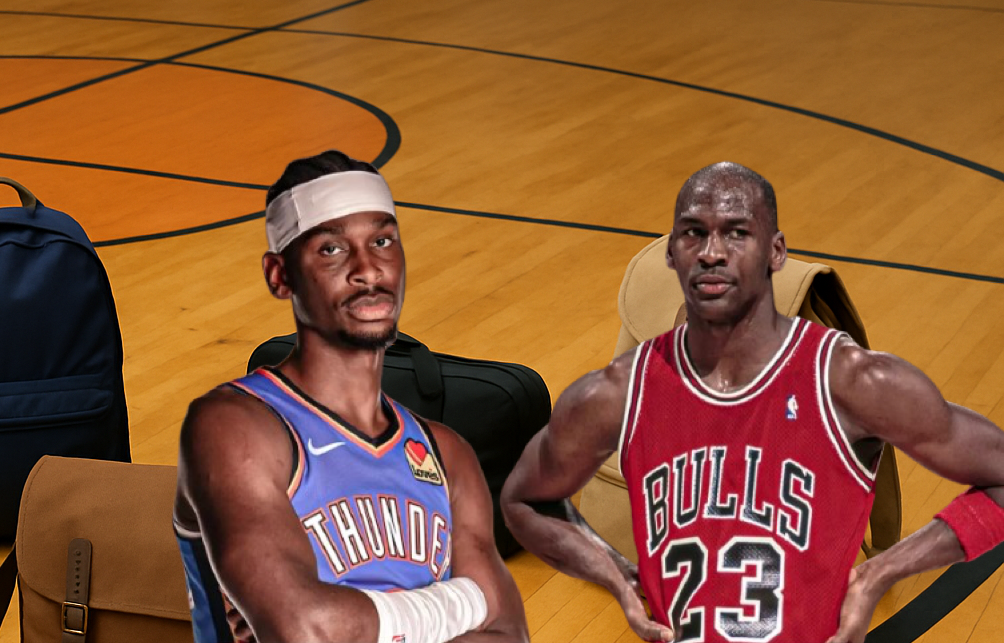
Paul Pierce and Danny Green ignited a fresh round of basketball discourse by suggesting Michael Jordan had a “limited” offensive bag compared to modern stars, punctuated by the line, “Shai got more bag.”
The remarks traveled quickly across social platforms, where the phrasing “limited bag” became the lightning rod. The core of their argument rests on the idea that contemporary perimeter scorers deploy a broader array of off‑the‑dribble moves, variations, and counters, and that Shai Gilgeous‑Alexander exemplifies that evolution.
Paul Pierce and Danny Green say Michael Jordan had a “limited” offensive bag 😳
“Shai got more bag.”
(🎥 @NFGShow / https://t.co/jlnDlgf5Qq) pic.twitter.com/UlnI2L430H
— NBACentral (@TheDunkCentral) December 1, 2025
The term “bag” in basketball vernacular refers to a player’s repertoire of moves, dribble packages, footwork variations, finishing angles, change‑of‑pace tools, and counters, rather than overall effectiveness or production. Pierce and Green’s framing separated aesthetics and variety from results, positioning Jordan’s attack as ruthlessly efficient and fundamental rather than maximalist in visible move diversity. It is a distinction that has surfaced often in debates comparing eras: older stars are framed as more direct and decisive, while modern guards are celebrated for layered, modular shot creation designed to solve increasingly complex defenses.
Jordan’s offensive profile, especially from the late 1980s through the Bulls’ second three‑peat, was built on elite footwork, strength, balance, and mid‑post mastery. His signature toolkit included jab series, triple‑threat pivots, rip‑throughs, turnarounds, pump‑fake discipline, and one‑ and two‑dribble pull‑ups, along with explosive straight‑line drives and hang‑time manipulation at the rim. He also thrived in structured actions, pin‑downs into curls, isolations with clear spacing, and mid‑post entries, where his precision and physical dominance erased the need for overt dribble ornamentation. In other words, his “bag” was condensed and repeatable, optimized for the era’s spacing and hand‑checking rules, and measured by inevitability more than flair.
Gilgeous‑Alexander, by contrast, operates in a modern context that rewards pace variability and micro‑deceptions. His hallmark is the cadence: hesitations, stride changes, and delayed pickups that force defenders to commit early or foul late. He blends slithery angles with extended gathers, off‑hand control, and a deep library of off‑dribble counters, step‑backs, side‑steps, inside‑outs, half‑spins, and touch finishes off two feet, with high free‑throw rates and a polished midrange. The offense around him stretches the floor with shooting and rangy screeners, creating lanes that showcase move diversity. In that sense, the “Shai got more bag” line points to stylistic breadth enabled by today’s spacing, rules, and skill emphasis.
Pierce and Green’s claim does not rewrite the record of scoring supremacy; it interrogates how fans value craft. Jordan’s résumé, scoring titles, playoff apexes, and high‑leverage dominance, suggests a “bag” defined by inevitability at scale. Shai’s ongoing run, marked by relentless 20‑plus point consistency and elite efficiency, highlights how modern creators use a wider palette to achieve similar impact possessions. The debate becomes less about who can score and more about what the path to those points looks like, and how eras sculpt that path.
