
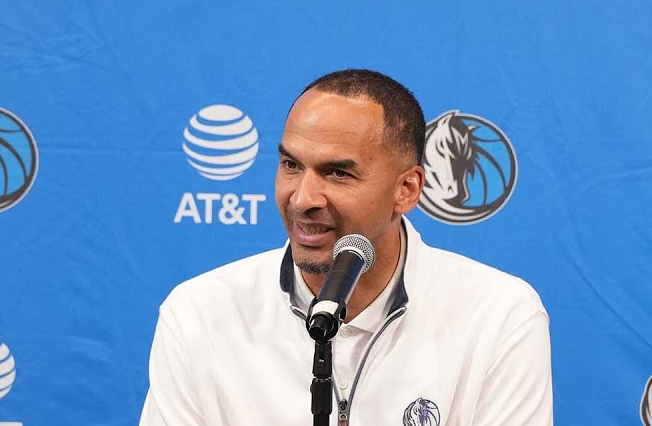
The Mavericks didn’t just change the nameplate on the GM’s door; they acknowledged a franchise-altering error and chose a harder, better path back to credibility. Nico Harrison wasn’t merely a pawn sacrificed for optics, his decisions put Dallas in zugzwang.
On November 11, 2025, the Dallas Mavericks dismissed general manager and president of basketball operations Nico Harrison after a 3–8 start. The move landed nine months after his most polarizing decision: trading Luka Dončić to the Los Angeles Lakers. In the immediate wake, Dallas named Michael Finley and Matt Riccardi as co-interim leaders of basketball operations.
“Fire Nico!” chants had been building for months and crescendoed during a gut-punch loss to Milwaukee; less than a day later, Dallas pulled the lever. You could call it reactionary. You could also call it responsible. I’ll go with the latter.
In chess, the pawn sacrifice is supposed to buy you tempo or open a file for something greater. Harrison’s version, moving on from a generational engine in Dončić, did neither. If it had, we’d be praising foresight. Instead, the gambit detonated the Mavericks’ offensive identity and locker-room gravity, and it strapped the franchise to an injury-volatile timeline that collapsed almost immediately. Anthony Davis, the centerpiece coming back, couldn’t stay on the floor; Dallas stumbled out of the gate; the backlash became a drumbeat. That isn’t calculated risk. That’s mis-valuation.
And whatever the internal rationale, Harrison publicly pointed to concerns about Dončić’s conditioning, the box scores in Los Angeles lit up like a pinball machine while Dallas’ halfcourt possessions looked like a long winter. The optics weren’t just bad; the scoreboard was worse.
You can botch a mid-level or whiff on a two-way. You cannot misread your franchise-defining superstar and the true value of leverage around him. Moving Dončić at the height of his prime, inside your building, inside your culture, demanded a slam-dunk return and a bulletproof plan. Dallas got neither. Ownership’s decision to cut ties acknowledges that the biggest decision went the wrong way, and that you don’t let the same hand reshuffle after a bust.
Dallas pivoted from a homegrown heliocentric model to an AD-anchored window that depends on availability. When availability failed, the floor vanished. The early-season record (3–8) wasn’t an unlucky blip; it was the predictable outcome of a misaligned roster philosophy.
A GM doesn’t coach, but he does set the temperature. The arena soundtrack turned combustible; chants, boos, the public second-guessing that saps patience and revenue. That’s not about thin skin; it’s about organizational oxygen. Dallas couldn’t breathe. Cutting off the source of the smog gives the locker room, the coaching staff, and the fan base a reset they all needed.
Harrison’s tenure wasn’t empty. Dallas reached the 2024 NBA Finals under his watch; a real accomplishment that will live in franchise history. But stewardship is a moving grade. The very same résumé that once read “innovative executive from Nike who helped build a Finals team” now includes the Dončić deal’s consequences. Owning both truths is adulthood for a franchise. Firing him honors the future without erasing the past.
Some will say November is too soon. That patience is a virtue. That sometimes the ball just doesn’t bounce. But this isn’t about a cold shooting week; it’s about structural integrity. Once the foundational move cratered, and the incoming timeline immediately frayed, the season wasn’t just rocky; it was mis-wired. If you already know the architect drew the wrong blueprint, you don’t wait for the roof to cave in over your rookies. You bring in new engineering.
Finley and Riccardi step in as co-interims. Give them a short runway to triage and collect clean intel across the league while ownership conducts a thorough search. Fresh leadership must be empowered, truly empowered, to make the next big calls without legacy baggage.
Dallas’ way back isn’t nostalgia; it’s alignment. Build around the player-development and draft capital you still control (headlined by No. 1 pick Cooper Flagg) and ring the phone on every veteran whose contract doesn’t match your new window. That doesn’t preclude winning; it clarifies how you plan to win.
Harrison’s gamble detonated Dallas’ on-ball identity. The next front office must choose a scheme and live in it… pace, space, and a core that can actually share the floor for 70+ games. The bar isn’t “flashy.” It’s “repeatable in May.”
Nico Harrison wasn’t just a pawn sacrificed to placate a restless crowd. Pawns are expendable by design; a lead executive isn’t. His choices, chiefly the Dončić trade, rearranged Dallas’ future, and when the future arrived, it didn’t fit. Firing him is the organization saying, out loud, that results and reasoning matter more than résumé and relationships.
It’s the right decision not because it’s ruthless, but because it’s honest. In chess, sometimes the only winning move is to admit the last one was a blunder, and then find check with clearer eyes.
