
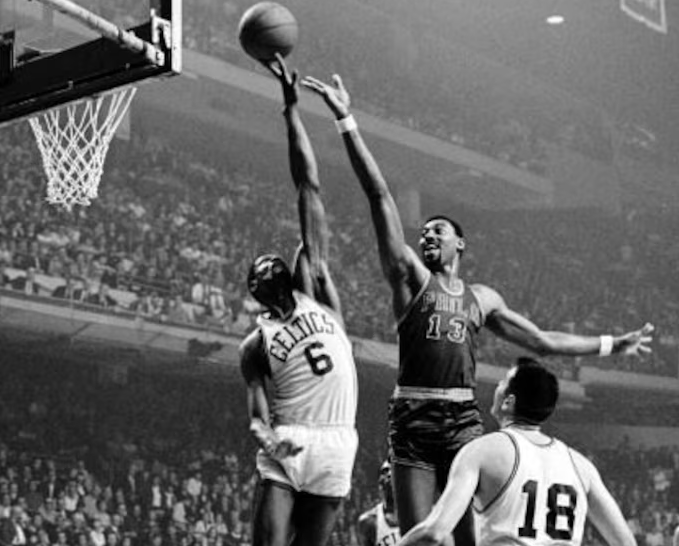
I. Opening bell: Boston Garden, November 7, 1959
The curtain rose on the greatest one-on-one theater the NBA has known: Philadelphia Warriors rookie Wilt Chamberlain, a behemoth of points waiting to happen, and Boston’s reigning MVP Bill Russell, the league’s defensive conscience. Their first meeting wasn’t a feel-out round so much as a mutual thunderclap.
Boston won 115–106, but the box score reads like a pair of manifestos: Chamberlain 30 points, 28 rebounds; Russell 22 and 35, all in a hail of contested hooks and breakneck rim runs that made the old Garden feel cramped.
That night told you everything and nothing at once. Wilt showed the raw, almost unfair ceiling. Russell showed the floor, victory by a thousand rotations.
II. The shape of a rivalry
From 1959 through Russell’s retirement in 1969, they met 143 times across regular season and playoffs. In those games, Chamberlain averaged 28.5 points and 28.1 rebounds, living at the edge of statistical imagination; Russell, the ultimate problem-solver, kept solving.
In the ledger of playoff series, the Celtics habitually had the last word. Boston won seven of their eight postseason meetings; the lone exception, more on it shortly, came when Wilt reimagined himself. Game by game, Russell’s teams were 29–20 versus Wilt’s in the playoffs, small numbers telling a large truth about margins, poise, and the value of the stop over the score.
III. The signature battles
1962: A seven-game vise
In the 1962 Eastern Division Finals, the Warriors and Celtics dragged each other to the brink. Game 7 at the Garden ended 109–107 for Boston, a two-point verdict on a week of trench warfare. It was the series that taught the league what a Russell-Wilt spring felt like.
1965: “Havlicek stole the ball!”
The rivalry’s most replayed heartbeat arrived in Game 7, 1965. Up one with five seconds left, Boston nearly kicked it away, Russell’s inbounds clipped the guide wire, before Hal Greer’s inbounds found John Havlicek’s fingertips and Johnny Most’s immortal call. Boston 110, Philadelphia 109. Russell survived; Wilt raged; history exhaled.
1967: Wilt learns to win a new way
Under coach Alex Hannum, Chamberlain pivoted, screening, passing, defending, swallowing a possession’s oxygen only when necessary. The ’67 76ers went 68–13, then beat Boston 4–1 in the East finals, finally bursting the green dam on the way to Wilt’s first title. It remains the year he most resembled Russell’s team-first silhouette; by choice, not limitation.
1969: Balloons and a farewell
Two years later, the last chapter of Russell-vs-Wilt doubled as Russell’s basketball goodbye. The 1969 NBA Finals became legend before the tip when the Lakers pre-staged a balloon drop in their rafters. In Game 7, Boston won 108–106; Wilt, then a Laker, briefly exited with a knee twist and returned to the scorer’s table only to remain benched by coach Butch van Breda Kolff, one of the rivalry’s enduring controversies. Russell walked off with his 11th ring and a final, quiet nod to the man who had made every one of those wins necessary.
IV. Beyond the box score: competitors, then friends, then competitors again
Publicly, the rivalry was a cultural referendum: Are you for the avalanche (Wilt) or the architect (Russell)? Privately, it was more intimate. They shared meals – famously, a Thanksgiving at the Chamberlain home – and a mischievous comfort around each other that only co-equals can earn. They laughed together on air and needled without venom.
The relationship frayed after 1969, when Russell questioned Wilt’s late-game absence in Game 7. The silence stretched for years before softening; time is undefeated, but so is respect. When Wilt died in 1999, Russell’s tribute cut through the noise:
“I’ve lost a dear and exceptional friend… the fierceness of the competition bonded us as friends for eternity.” He delivered a eulogy and called Wilt an “eternal friend.”
That’s not spin; that’s a summation.
V. What they proved… together
Chamberlain proved that the box score could be a novel and still undersell the plot. He showed us the borders of production and then sketched beyond them: 100 points, 50.4 per game in 1961–62, rebounding totals that read like typos. Russell proved that a possession is a symphony, timing, angles, anticipation… and that leadership is the most additive stat of all. Their collision forced coaches to innovate and teammates to choose higher forms of basketball.
Crucially, each gave the other a reason to become better. The rivalry demanded Wilt’s 1967 reinvention and polished Russell’s defensive genius against the only force in the sport big enough to dent it. Their names are often used to argue “best”; the smarter conversation is how, together, they made “best” more complicated and more beautiful.
VI. Final buzzer
From that first night, Nov. 7, 1959, until the balloons gathered dust and Russell waved goodbye, the game bent toward these two centers of gravity. If you tally titles, Russell wins. If you stack numbers, Wilt overwhelms. If you ask the sport what it remembers, the answer is simpler: the way the room felt when they faced each other; how the floor seemed to shorten and the rim to shrink; how every cut, hedge, tip-out, and put-back became a referendum on excellence.
It was competition that matured into kinship, an arms race that became a handshake. And it began, properly, with a standoff that told us everything and nothing, because everything that mattered was still to come.
