
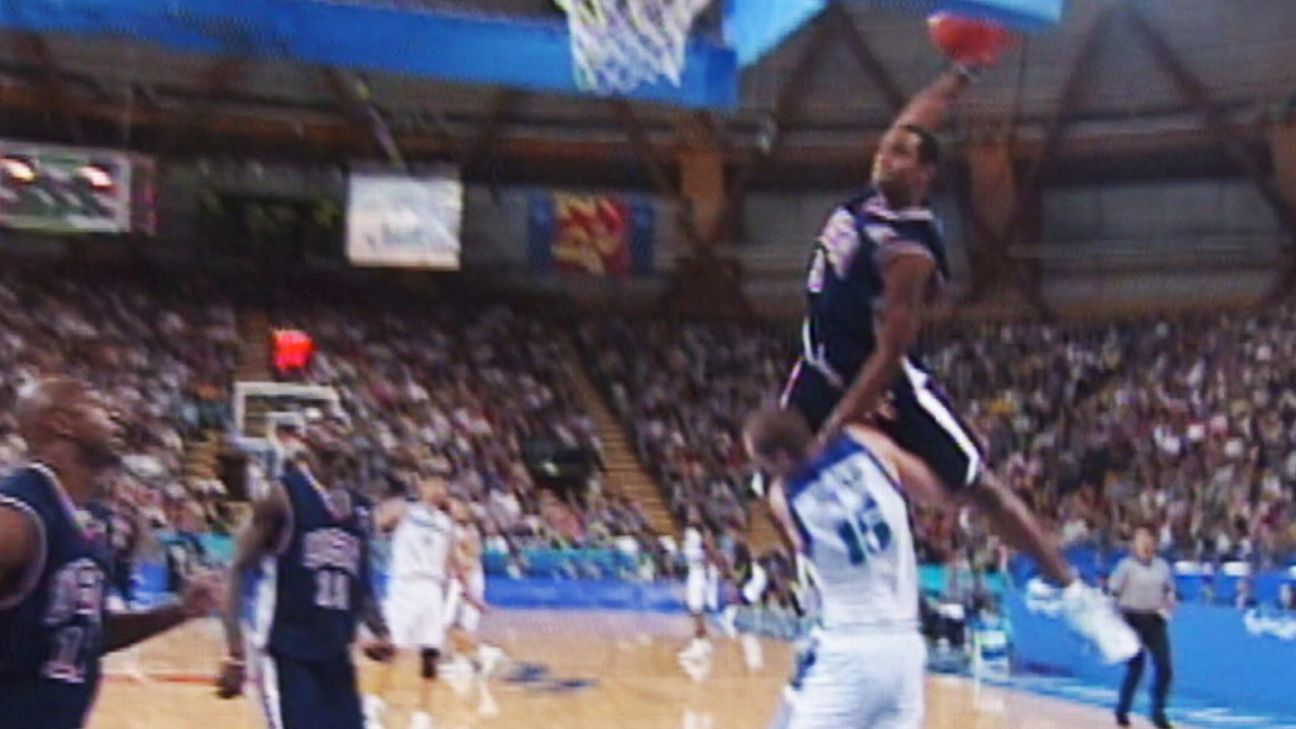
A quarter of a century has passed, yet the image remains as vivid as ever: Vince Carter, soaring through the air in Sydney, leaping clean over 7’2” French center Frédéric Weis, and hammering home a dunk that would forever be known as “Le Dunk de la Mort”; the Dunk of Death.
It was the summer of 2000, and Team USA was facing France in a group-stage game at the Olympics. With 16 minutes left in the second half, Carter intercepted a pass, took two dribbles, and launched himself toward the rim. Weis, planted firmly in the lane, seemed like an immovable obstacle. Instead, Carter turned him into a prop in one of the greatest highlights the sport has ever seen.
“He didn’t jump, he flew,” Weis later admitted, still in awe of the moment that would define both men’s careers in very different ways.
The United States went on to win the game 106-94 and eventually secured the gold medal, defeating France again in the final. But the tournament is remembered less for the medal count and more for that single play. French newspapers the next morning splashed the headline “Le Dunk de la Mort”, cementing the moment in basketball folklore.
For Carter, then just 23 and fresh off his legendary 2000 NBA Slam Dunk Contest performance, the dunk was a coronation. It confirmed his status as “Half-Man, Half-Amazing,” a player whose aerial artistry could defy physics and humiliate even the tallest defenders.
For Weis, the dunk became an unwanted legacy. Drafted by the New York Knicks in 1999 but never playing a game in the NBA, he would later admit that for many fans he was remembered only as “the guy Vince Carter dunked on.” His career in Europe was respectable, but the shadow of that Olympic moment followed him everywhere.
Twenty-five years later, the dunk remains a staple of highlight reels, documentaries, and debates about the greatest plays in basketball history. It wasn’t just the athletic feat, it was the audacity. Carter didn’t just dunk over a man; he dunked over a man who stood 7’2”, in an Olympic game, with the world watching.
